Now also free widgets

Prev

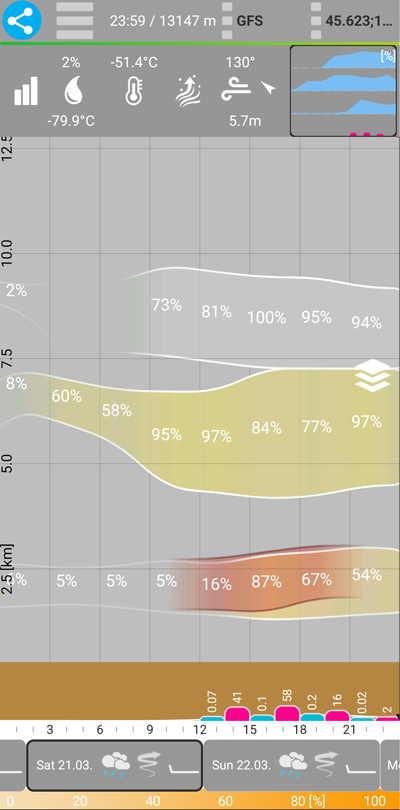
In the upper navigation list, we can schematically see 3 cloud layers, CAPE index and precipitation.

On the main screen we see 3 layers of clouds and their development during the day. We see their thickness, lower and upper limits and percentages. Everything is measured against the real values of the prediction model. The color of the clouds corresponds to the color of the clouds on the map.
This cloud screen cannot be zoomed.

In the lower part of the main screen, we can see the precipitation and the cape index and their course during the day.

alt
simplified view of clouds, rainfall and CAPE index
all level clouds, cover and thickness
CAPE index and precipitation

Convection base, Classic cumulus day

alt

One-sentence summary:

Low convection + moderate thickness = the best thermal day. High convection within mid-level cloudiness = more of a “layer/embedded” convection, not clean ground-based thermals. Large convection thickness = strong climbs, but the risk of showers/thunderstorms increases.

What it looks like:

the convection base is close to KKH/CCL and often matches the base of low cumulus cloudiness convection thickness is typically 1–3 km – fair-weather cumuli without a pronounced thunderstorm development

What it means for flying:

a typical thermal day with cumuli, good readability of lift, and often the best conditions for XC (Values are indicative – they depend on season, humidity, temperature, etc.)

Narrow convection in a mid-level layer (elevated / embedded)

alt

What it looks like:

the convection base lies clearly above KKH/CCL the convective band is rather narrow – convection thickness is usually up to ~2 km convection often appears within mid-level cloudiness or just beneath it (not a “clean cumulus” sky)

What it means for flying:

near the ground thermals may be weaker or only local (sunny windows, cloud edges, slopes) and are harder to read from cumuli the air aloft can feel “livelier” (more turbulence/variability

Deep convection

alt

→ strong climbs and sink, turbulence, often showers and increased risk of thunderstorms/outflow. For paragliding this is generally unsuitable.